Views: 4 Author: Site Editor Publish Time: 2025-10-23 Origin: Site
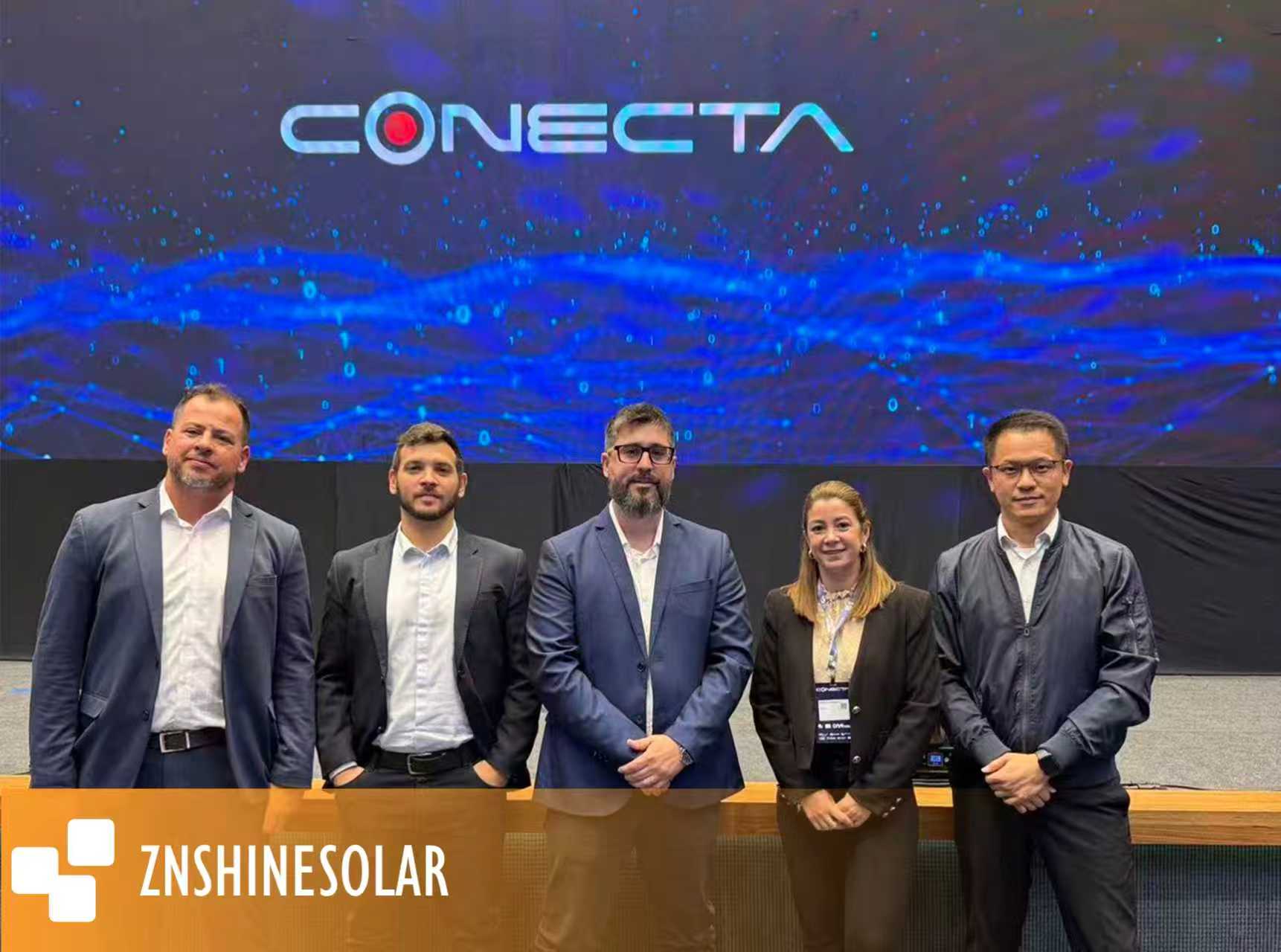
Recently, the ZNSHINE SOLAR Brazil team was invited to attend the 5th Canal Conecta conference held in São Paulo. As a leading event in the Brazilian renewable energy sector, this year’s conference brought together energy companies, industry experts, regulatory agencies, and financial institutions from around the world and Latin America to discuss new opportunities for Brazil's energy transition and technological innovation.
Canal Conecta is organized by Canal Solar, a well-known energy media in Brazil. Over the years, it has become an important platform connecting upstream and downstream sectors of the industry. The conference was themed "Innovation, Sustainability, and Cooperation" and focused on cutting-edge topics such as Battery Energy Storage Systems (BESS), Curtailment, Carbon Markets, Electric Mobility, Financing, and Subscription-based PV. Experts from organizations such as ANEEL (Brazilian National Electric Energy Agency) shared professional insights on energy structure optimization, the commercialization path for energy storage systems, and the development of carbon credit markets.
At this year’s conference, the ZNSHINE SOLAR Brazil team actively participated in industry exchanges, engaging in in-depth discussions with local partners, distributors, and energy experts on the innovative applications and business models of photovoltaic systems. The team showcased ZNSHINE SOLAR's latest high-efficiency N-type module products introduced in Brazil— the 610W monofacial module and the 650W bifacial module. Both products utilize advanced N-type cell technology, featuring high conversion efficiency, low temperature coefficient, and excellent degradation performance. They are designed to maintain stable and efficient power generation performance in Brazil's diverse climatic conditions, providing more reliable solutions for various application scenarios.
The ZNSHINE SOLAR N-type modules, with their efficient and low-loss design philosophy, provide a solid foundation for reducing costs and improving efficiency in photovoltaic systems. Their power temperature coefficient is only -0.28%/°C, ensuring excellent performance even in Brazil’s high-temperature climate. Additionally, the bifacial rate of the modules is over 80%, enabling the full utilization of ground-reflected light to enhance overall power generation efficiency. The 650W bifacial module is especially suitable for ground-mounted power stations and areas with higher albedo.
In terms of reliability, the ZNSHINE SOLAR N-type modules use N-type phosphorus-doped silicon technology, which eliminates the electron losses caused by traditional boron-oxygen complex centers, resulting in almost no light-induced degradation. The first-year degradation is only 1%, and the bifacial module’s annual degradation is just 0.4%, significantly lower than traditional modules, ensuring long-term power generation stability. The application of SMBB technology effectively reduces the use of silver paste and improves packaging efficiency, significantly lowering packaging power losses. Furthermore, the adoption of non-destructive cutting technology reduces the risk of micro-cracks in the cells, enhancing the overall reliability and lifespan of the modules.
For years, ZNSHINE SOLAR has been deeply engaged in the Brazilian market, relying on a professional local team and a well-established channel network to continuously provide high-quality products and efficient, timely technical support to customers. This year, the company, with its strong brand strength and continuous technological innovation, was awarded the "Top Brand PV" and "Top Innovation" titles in Brazil by the internationally recognized agency EUPD Research. ZNSHINE SOLAR consistently adheres to the philosophy of "customer first, quality foremost," drives development through innovation, earns trust through service, and continues to help customers achieve long-term, stable returns in a competitive market, making green electricity more efficient!

The ZNSHINE Integrated PV, Energy Storage, and Charging System is built around the core concept of efficient and intelligent energy management, combining photovoltaic, storage, and charging functionalities. Tailored for residential, commercial, and industrial applications, this all-in-one clean energy solution leverages ZNSHINE's extensive expertise in the photovoltaic industry. Its flexible modular design caters to diverse application scenarios, significantly enhancing energy utilization efficiency while providing users with a low-carbon, convenient green energy experience.
In line with the global trend of energy structure adjustment and low-carbon development, ZNSHINE SOLAR introduces the ZNSHINE Integrated PV, Energy Storage & Charging System. Through technological innovation and efficient management, the off-grid mode of the system has become a new solution to address energy challenges in remote areas and regions with weak grid coverage. The ZNSHINE Integrated PV & Energy Storage System integrates photovoltaic power generation, energy storage, and intelligent control, offering high reliability and strong adaptability to provide users with sustainable clean energy solutions.
Industrial and commercial energy storage systems, as innovative power management solutions, are transforming the way businesses and enterprises utilize energy. By storing electricity during off-peak hours and discharging during peak times, these systems help reduce energy costs while serving as emergency power sources to ensure continuous supply during unexpected outages. This article delves into the energy storage segment of ZNSHINE’s Integrated PV&ES&CS System, showcasing its unique features and application advantages.
In recent years, the rapid development of solar photovoltaic (PV) technology has been accompanied by the continuous iteration of solar cell sizes. From the early 156mm era to today’s widespread use of larger 182mm and 210mm cells, each technological advancement has driven improvements in module power and optimization of system costs.
Graphene is hailed as the most revolutionary material of the 21st century, earning the title of "king of new materials" due to its exceptional properties. Composed of a single layer of carbon atoms arranged in a honeycomb lattice, graphene exhibits a range of remarkable physical characteristics. It is 100 times stronger than steel and has excellent electrical conductivity, with its carrier mobility at room temperature being approximately 10 times that of silicon. Additionally, graphene boasts outstanding thermal conductivity, with a thermal conductivity coefficient of up to 5300 W/mK, far surpassing most materials. Graphene is also nearly transparent, with an absorption rate of just 2.3% in the optical range. It retains excellent flexibility, allowing it to bend and deform while maintaining its structural integrity. These unique properties make graphene a material of enormous potential across various fields and are widely believed to herald a materials revolution.
When purchasing solar modules, performance and price are the two key factors to consider. The performance of a solar module depends not only on its photovoltaic conversion efficiency but also on the strength and durability of its structure. As a crucial support and protective component, the frame material has a direct impact on the overall performance of the module. Additionally, solar module frames, being high-value auxiliary materials, play a significant role in the module’s total cost structure. For instance, *the commonly used aluminum frame, with its strong mechanical properties, accounts for around 13% of the total module cost—surpassing other auxiliary materials like EVA, glass, backsheets, and solder ribbons—second only to the 55% cost share of the solar cells themselves.
Installing a solar photovoltaic (PV) system on a roof is a crucial process that requires ensuring the system efficiently captures solar energy while maintaining its safety and stability. This article will describe how to use the SRS (Solar Racking System) to install PV modules more securely and efficiently.
Una célula fotovoltaica es algo relativamente sencillo. Un material semiconductor, en el que se ha creado un diodo (se le ha dado polaridad), al que se le pone una capa azul antirreflejante y se conectan unos conductores eléctricos para extraer la electricidad. Digamos que la arquitectura de la célu